

Autism Advocacy: Practical Ways to Turn Awareness Into Action
Learn respectful, practical ways riders, volunteers, donors, and partners can support autistic people and strengthen local autism organizations.
Autism advocacy is most useful when it starts with listening and leads to practical support shaped by autistic people themselves. Riders, volunteers, donors, and community partners can help make that support visible and lasting by asking what people want, making participation more accessible, and backing local organizations doing work in their communities.
Explore ways to join a charity ride and support local organizations
What does respectful autism advocacy look like?
Advocacy is not simply speaking about autism or raising awareness of a cause. It means supporting autistic people as participants in decisions that affect their lives, and helping remove barriers to their choices, relationships, education, recreation, and community life. The self-advocacy resource from HANDS in Autism at Indiana University describes self-advocacy as active participation in decisions about one’s own life. That is a useful starting point for community groups, too: ask, listen, and make room for people to express what matters to them.
Respectful advocacy does not assume every autistic person has the same preferences, support needs, or way of communicating. Some people may want to speak for themselves in a meeting; others may communicate in different ways or prefer a trusted support person to help. The practical question is not, “What do autistic people need?” as if there were one answer. Ask the individual, family, or organization involved what would help in this situation, and respect the answer.
It also helps to think beyond a single awareness event. A welcoming invitation is meaningful, but people need the opportunity to participate, return, build relationships, and shape what happens next. Autism advocacy can be a repeated practice: listen before planning, make access needs part of the plan, follow through on commitments, and check whether the effort is useful to the people it is meant to serve.
How can you listen before deciding what support is needed?
Start with the people closest to the question. If you are planning a ride, fundraiser, volunteer project, or community gathering, invite autistic participants and local organizations to share their perspectives early enough to influence the plan. Asking for feedback after every decision has been made can put the burden on people to approve a finished product rather than shape it.
- Ask open, specific questions. For example: “What would make it easier for you to take part?” or “Would written instructions, a quieter check-in area, or another option be useful?” Offer choices without assuming which one is right.
- Make it possible to respond in different ways. A conversation may work for one person, while another may prefer an email, a form, a support person, or more time to think. Explain how input will be used and provide a reasonable way to follow up.
- Listen without asking someone to represent everyone. One person’s experience is valuable, but it is not a universal account of autism. Build relationships with several local voices and organizations where appropriate.
- Close the loop. Tell people what changed because of their input, what could not change, and why. Thank them for the time and expertise they shared.
Listening should not become unpaid, repeated work that an organization expects from the same individuals. If you ask someone to advise on an event or program, clarify the scope, timing, and format. Where an advisory role calls for substantial ongoing work, consider how the organization can recognize and support that contribution.
What can event organizers do to make participation more welcoming?
Inclusion works best when it is part of event planning rather than an afterthought. A charity ride, for example, involves much more than the miles on a route. Participants may need clear information about registration, schedules, route choices, rest stops, transportation, and whom to contact with a question. Organizers can make those details easier to find and use.
A useful planning sequence is to map the participant experience from the first announcement through the trip home. Consider how someone finds the event details, registers, reaches the start, checks in, follows route instructions, asks for help, and leaves. At each point, ask where information might be missing or where a participant must rely on guesswork. For example, if check-in opens at a certain time, explain what happens there and where a participant can ask a private question. If route options differ, describe the relevant distances and support arrangements rather than relying on a map alone. Review the plan with people who will use it before treating it as finished.
- Share practical information in advance. Describe the event schedule, route options, check-in process, and what happens at key points. Make directions easy to follow and provide a contact path for questions. Bike to the Beach posts event and route information, including details for the DC and Maryland ride and navigation information.
- Ask about access needs privately. Give participants a way to communicate a request without having to share personal information publicly. Avoid promising that every request can be met; explain what the team can confirm and by when.
- Offer choices where possible. Different routes, participation roles, or ways to be involved may suit different people. Explain the options clearly instead of treating one kind of participation as the only meaningful one.
- Prepare volunteers to respond respectfully. Give volunteers simple guidance on where to direct questions, how to offer help without insisting, and how to respect a participant’s stated preferences. They should not guess at someone’s needs or make a diagnosis.
- Review the experience afterward. Ask participants what worked, what created friction, and what they would change. Carry those lessons into the next event.
These steps are not a substitute for individualized planning. They create a better starting point and make it easier for a participant to explain what works for them. The event’s own logistics also matter: Bike to the Beach describes ride support such as rest stops and mechanical assistance in its event information. Readers considering a particular ride can use the relevant regional page, such as the New England ride information, to review available details and ask questions before registering.
How can riders and families turn a ride into advocacy?
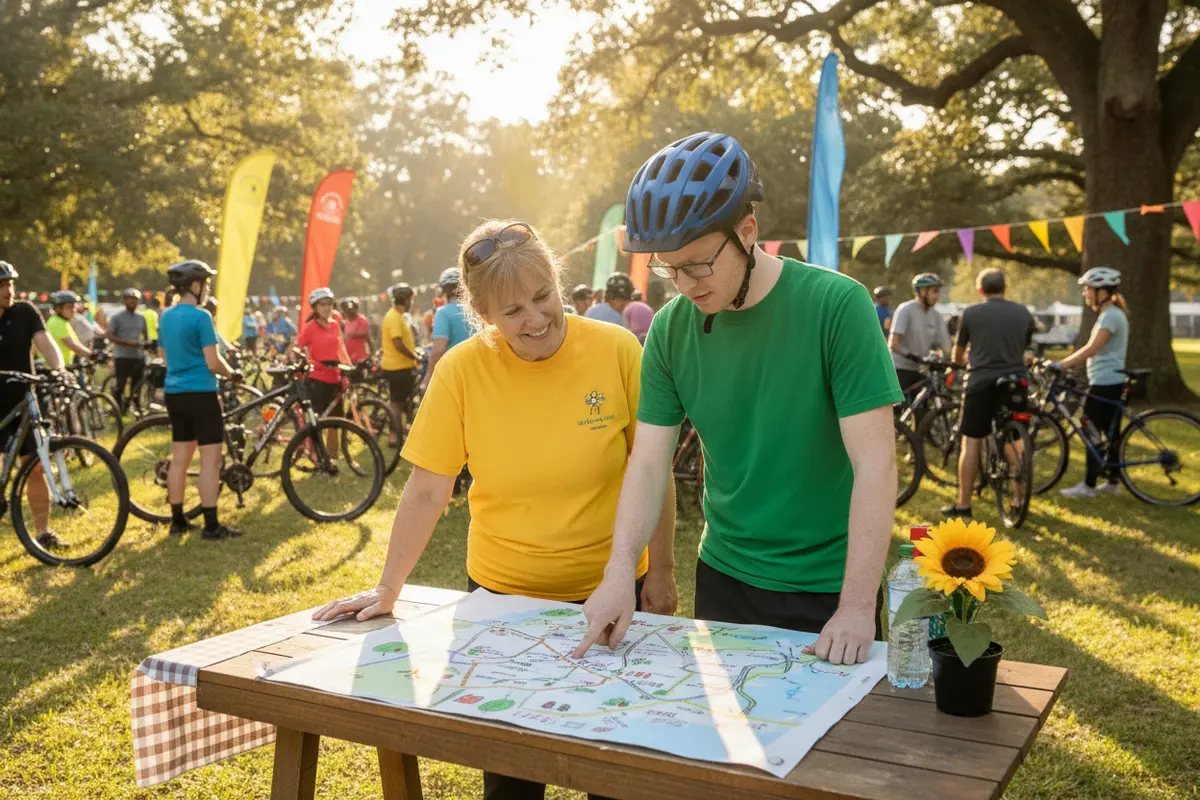
A charity ride can be one practical way to connect physical activity with local support. The advocacy value comes not just from completing a distance, but from how participants engage with the cause and the community around it. Before an event, learn which organizations benefit and what kinds of local work they support. Then share that information accurately with friends, teammates, and donors.
For riders, a few useful habits include:
- Explain why you chose to participate without suggesting that one ride solves a complex issue.
- Ask the beneficiary organization how it wants its work described, and use its preferred language.
- Invite people to support the event in a way that fits their interests, whether that is riding, fundraising, volunteering, or sharing information.
- Make space for autistic people to tell their own stories if they choose, rather than asking others to speak for them.
- After the event, share what you learned and stay connected to the organizations and people you met.
Families can begin with a conversation about what kind of involvement feels enjoyable and manageable. A person may want to ride, help a team, attend part of an event, or take part in a different way. Review the schedule and route information together, identify questions in advance, and decide what information the participant wants to share with event staff. Keep the person’s preferences central rather than treating family participation as one fixed model.
If a long ride is not the right fit, advocacy does not depend on cycling. A person can support a team, help with an event task, invite a local organization to speak, or learn about the groups serving their community. Bike to the Beach offers information about bike fundraising events and shares stories about community impact that can help readers understand the organization’s broader mission.
How can volunteers, donors, and partners contribute?
Different roles can support local autism and disability organizations in different ways. A volunteer may make an event easier to navigate. A donor can help sustain an organization’s work. A corporate or community partner can contribute time, resources, or a team of people. The best contribution is not always the largest or most visible one; it is the one that responds to a real need and can be followed through reliably.
| Role | Practical first step | Helpful follow-through |
|---|---|---|
| Rider or fundraiser | Learn about the local organizations connected to the event and ask how to describe their work accurately. | Share updates, thank supporters, and stay connected after ride day. |
| Volunteer | Ask which tasks need support and what training or instructions are provided. | Arrive when agreed, follow participant preferences, and share useful observations with the organizer. |
| Donor | Find out which organization or event your contribution supports and how to give through the appropriate channel. | Keep the organization’s communications and impact updates in view, and ask questions if anything is unclear. |
| Business or community partner | Talk with the nonprofit about its priorities and what support would be useful. | Agree on responsibilities, timing, and how the partnership will be communicated. |
Bike to the Beach’s model connects its rides with local autism and disability organizations, and its sponsorship information describes a path for organizations interested in supporting its work. A prospective partner should discuss the fit and expectations directly rather than assume that every offer is useful in the same way. If a school, service organization, or community group is involved, include its representatives in planning and agree on how each organization will be named and represented.
It can help to turn a general offer into a clear agreement. A community partner might first ask which task or resource is currently useful, who will coordinate it, and when a decision is needed. The organization and partner can then agree on practical details: what each side will provide, how participants will receive instructions, who handles questions, and how the contribution will be acknowledged. A brief written recap prevents misunderstandings and gives both sides a chance to correct assumptions before work begins. After the activity, check whether the support met the need and whether the arrangement should change next time. This modest cycle – ask, agree, deliver, review – makes collaboration more dependable without assuming that one format suits every organization.
Volunteering can be a meaningful route into advocacy because it lets people contribute to a shared effort. It is most helpful when the role is clear: know where to report, what task you own, whom to ask for help, and how to respond if someone raises an access concern. Follow the organizer’s instructions and avoid making commitments on behalf of the nonprofit or the people it serves.
How can an organization tell whether its advocacy is useful?
Good intentions do not tell you whether a program or event is working for the people it aims to serve. Use feedback and practical review to learn. After an activity, ask participants whether information was clear, whether they could take part in the way they wanted, and what they would change next time. Offer more than one way to respond, and avoid treating silence as proof that everything went well.
Review the process as well as the outcome. Did organizers ask for input early? Were questions answered? Did volunteers know how to offer help respectfully? Were agreed tasks completed? These questions can lead to concrete improvements, such as revising instructions, changing a check-in step, or sharing details earlier. Record lessons so they are available to the next planning team rather than relying on memory.
Organizations should also be careful about claims. Describe the activity and its purpose accurately. Do not imply that one event speaks for all autistic people, or that a single donation guarantees a particular result unless the organization has clearly established that connection. When explaining how fundraising is used, refer to information provided by the beneficiary or event organizer. Bike to the Beach describes its local partner focus in its organization background; readers can use that information as a starting point for learning about its approach.
What should you avoid when supporting autistic people?
Advocacy can miss its purpose when it centers the helper instead of the person or community being supported. A few safeguards help keep the work grounded:
- Do not assume one person’s experience represents everyone. Ask the person involved and respect individual preferences.
- Do not share someone’s personal story, image, or diagnosis without permission. A public campaign is not a reason to bypass consent.
- Do not make access promises you cannot confirm. Be clear about what you know, what you are checking, and when you will respond.
- Do not treat participation as a public performance. People can contribute without disclosing personal details or serving as spokespeople.
- Do not stop at a symbolic gesture. Follow through on commitments and use feedback to improve future activities.
A shift from awareness to acceptance is also about how people are welcomed and included in ordinary community settings. The Dan Marino Foundation’s discussion of autism awareness and acceptance is one perspective on that distinction. The practical test for any group is whether autistic people have meaningful opportunities to participate and influence the experience, not simply whether the group has made a public statement.
Explore volunteer opportunities with Bike to the Beach
Frequently Asked Questions
What is a practical first step in autism advocacy?
Ask autistic people or local organizations what support would be useful in the specific situation. Listen to the answer, provide a clear way to follow up, and act on what you learn rather than assuming that a familiar activity is automatically helpful.
Can I support autism advocacy if I am not a cyclist?
Yes. You can learn about local organizations, volunteer for an event, donate through an appropriate channel, or work with a community group or business to provide support. Choose a role that matches a real need and your ability to follow through.
How can a charity event be more inclusive?
Share clear information in advance, invite access questions, offer choices where possible, prepare volunteers to respond respectfully, and ask participants what to improve afterward. Do not assume that one change will meet every person’s needs.
Should I speak on behalf of an autistic person?
Do not assume that you should. Ask whether the person wants you to help communicate, and follow their preference. When sharing a broader message, avoid presenting one person’s experience as universal and make room for autistic people to speak for themselves if they choose.
How can I tell whether my support made a difference?
Ask the organization or participant what changed, review whether your commitments were completed, and invite specific feedback about the experience. Use that information to improve the next effort rather than relying only on the number of people who attended or the visibility of the activity.
Ready to put community support into practice?
Explore a Bike to the Beach charity ride and ways to participate
Autism advocacy grows through respectful relationships and steady follow-through. Start by listening to the people closest to the question, choose a practical way to help, and keep learning from the community you hope to support.